Cold Plunge for Women: A Cycle-Synced, Evidence-Based Protocol
The short answer
In early 2025, a clip from a hugely popular podcast ricocheted around the internet with a message that stopped a lot of women mid-reach for the ice tub: cold plunging might not be for you. The expert was exercise physiologist Dr. Stacy Sims. The takeaway many people heard was simpler and scarier than what she actually said — that women should step away from the cold.
Here's the honest answer up front: cold plunge for women is not only safe for most women, it can be genuinely useful — for mood, stress resilience, and (per a large survey of 1,114 women) menstrual and perimenopausal symptoms. What changed in 2025 wasn't the science. It was the conversation finally catching up to the fact that female physiology isn't male physiology with extra steps.[1]
This article walks through what cold water actually does in the female body, a phase-by-phase protocol for your menstrual cycle, how cold exposure fits into perimenopause and menopause, the cortisol question everyone asks, and a conservative four-week plan to start. No dogma — just what the research and experienced practitioners recommend, and where the evidence is still thin.
Why 'Should Women Cold Plunge?' Became 2026's Biggest Wellness Debate
The spark was Dr. Stacy Sims — an exercise physiologist and author of ROAR — appearing on shows like The Mel Robbins Podcast in early 2025. Her core, reasonable point: most cold-exposure research was built on male bodies, and women respond differently, especially across the menstrual cycle. She recommended warmer water for women (around 15–16°C / 59–60°F) and raised fair questions about cortisol and the luteal phase.
What got clipped and recirculated was blunter: cold plunging is bad for women. Sims has since clarified that she never said women shouldn't cold plunge — only that the evidence points to warmer temperatures working better for them. Worth remembering, because the distortion is what scared people off.
On the other side, Dr. Susanna Søberg — the metabolic scientist behind the widely cited '11 minutes a week' cold-exposure framework — pushed back clearly. 'The biggest misconception around extreme temperatures is that women shouldn't cold plunge,' she says. Her position: women aren't too sensitive; they need nuanced, cycle-aware guidance.[2]
And then there's the data. In 2024, researchers surveyed 1,114 women who regularly swim in cold water. The majority said it eased menstrual symptoms (anxiety dropped for 46.7%, mood swings for 37.7%) and perimenopausal symptoms (hot flushes improved for 30.3%).[1]
One honest caveat before we go further: a 2025 meta-analysis of 11 cold-water-immersion studies (3,177 people) found real benefits for stress and sleep quality — but only one of those 11 studies actually included women. So when we talk about female-specific effects, we're often stitching together smaller studies, surveys, and physiology, not gold-standard trials.[3]
What Cold Water Actually Does to the Female Body
Drop into cold water and your body reacts in seconds. Skin sensors fire, blood vessels at the surface clamp down (vasoconstriction), and your brain releases a rush of noradrenaline and dopamine — the chemicals behind the post-plunge clarity and lift. Søberg describes it as a 'control-alt-delete' for the brain.[2]
Here's the female-specific wrinkle. Women tend to vasoconstrict more readily than men and start shivering at higher water temperatures — which is exactly why Sims argues for a warmer starting range. But women also carry more brown fat (the metabolically active fat that burns energy to make heat), and Søberg notes women can activate it effectively. The net effect, in her words: men and women 'defend the cold equally, but how they do it is just different.'[2]
That brown fat matters. A controlled temperature-acclimation study found that mild cold boosted brown fat activity reversibly, alongside better insulin sensitivity. Cold is one of the few reliable ways to switch that tissue on.[4]
For recovery, the picture is solid but qualified. A Cochrane review of 17 trials found cold-water immersion reliably reduced muscle soreness after exercise compared with rest. But a 2015 study showed doing it right after strength training can blunt long-term muscle and strength gains — so time it around your goals.[5], [6]
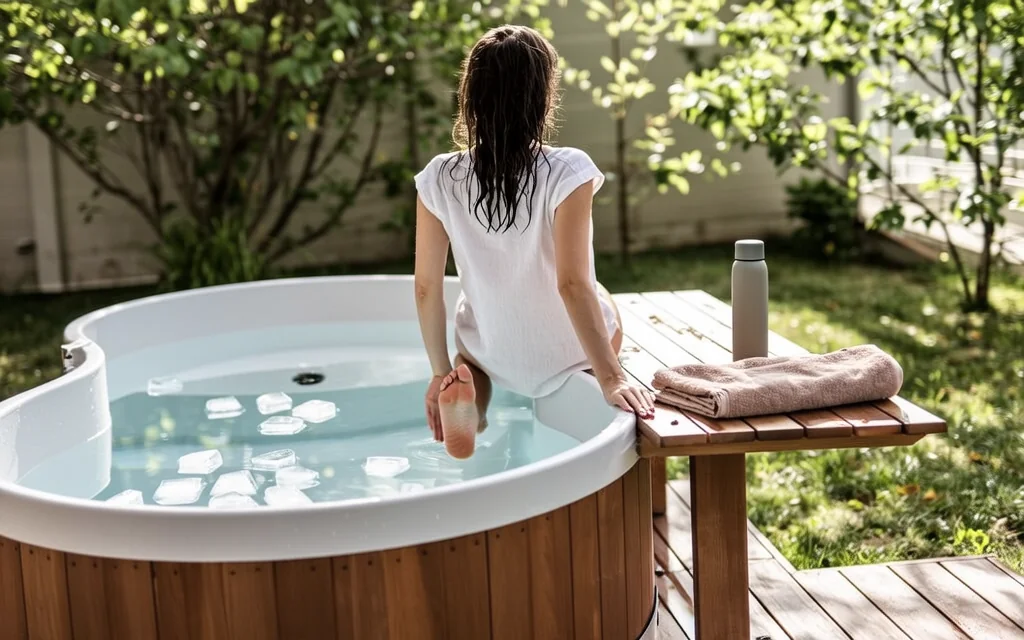
Cold Plunge by Menstrual Phase: Follicular vs Luteal
Your hormones shift across the month, and so does your response to cold. The cold plunge menstrual cycle question comes down to two phases. After ovulation, progesterone rises and nudges core temperature up, which can make the same plunge feel sharper in the second half of your cycle. The cold plunge luteal vs follicular phase split matters because of exactly that.
Søberg's practical read: the follicular phase (first half) is usually your strong window; the luteal phase (second half) calls for shortening or softening. Here's a phase-by-phase starting point — treat it as a dial, not a rulebook.[2]
- Follicular phase (roughly days 1–14, from your period through ovulation): estrogen is rising and you tend to feel more cold-resilient. This is the window to push a little — Søberg suggests about 1–4 minutes at around 15°C. If you're building tolerance, this is the time.
- Ovulation to mid-luteal (roughly days 15–21): still fine for most women. Keep sessions in the 1–3 minute range and watch how you feel. Progesterone is climbing, so the cold may register as more intense than it did two weeks earlier.
- Late luteal / PMS (roughly days 22–28): this is where the 'consider shortening or skipping' advice lives. Søberg suggests 1–2 minutes, a brief cold shower, or simply waiting out the week. Many women report cold actually helps PMS mood — but if you feel drained or more stressed, less is more.
- Cold plunge during period: totally fine if you feel up to it. Some women find it helps cramps and mood; others prefer to skip a few days. Both are normal.
The 1,114-woman survey backs up that last point — menstrual-symptom relief was common among regular cold-water swimmers, with anxiety and mood swings among the most-eased.[1]
And notice the Harvard finding from that meta-analysis: men — but not women — reported sleeping better after ice baths. We don't fully know why, but it's one more reason not to copy a male-designed protocol and assume it lands the same way for you.[7]
Perimenopause & Menopause: A Non-Hormonal Tool for Hot Flashes & Mood
This is where the cold story gets interesting for women in midlife. In the 1,114-woman survey, 63.3% of perimenopausal women said they swam in cold water specifically to ease symptoms — and reported real relief: anxiety down 46.9%, low mood down 31.1%, hot flushes down 30.3%.[1]
For cold plunge perimenopause menopause symptom relief, the data is encouraging but not proof. The study is self-reported with no control group, so we can't claim causation. 'Promising' is the right word, and it's low-cost and low-risk for most. Cold plunging is not, and never should be, pitched as a replacement for HRT or medical care.[1]
The mechanism is plausible. Cold exposure trains your stress-response system (the HPA axis) and releases dopamine and noradrenaline, which lift mood and focus. For women navigating the mood swings and sleep disruption of perimenopause, that's a reasonable, non-hormonal adjunct — alongside, not instead of, whatever your clinician recommends.[2]
The Cortisol Myth: Acute Spike vs Chronic Adaptation
The fear that gets repeated most: cold plunging spikes cortisol, and for women under chronic stress that's supposedly harmful. Let's separate the two halves of that claim.
First, yes — a cold plunge is an acute stressor, and your cortisol can rise during the first few sessions, especially if you're nervous getting in. That's normal. Søberg notes this early spike is largely tied to anticipation, and it fades as you adapt.[2]
Second, the part that gets left out: with regular practice, your baseline cortisol tends to come down. The 2025 meta-analysis found stress was significantly lower about 12 hours after immersion. That's the adaptation — your nervous system gets better at handling stress, cold or otherwise.[3]
The one real caveat for women: if you're plunging aggressively in the late luteal phase while already stressed, you may be stacking stressors your body doesn't need that week. That's the nuance Sims was pointing at — not 'cold is bad for women.'[2]
Safety First: Pregnancy, Hormonal Contraceptives, Thyroid & When to Stop
Cold plunging is safe for most healthy adults, but it is a genuine physiological stressor. A few groups should either avoid it or get clearance first. This is the part to read carefully.
Pregnancy: skip it. Is cold plunge safe during pregnancy? The short answer is no. Søberg's blunt advice: 'If you are pregnant, also just skip it for these nine months.' We simply don't know enough about cold exposure's effects on the fetus, so the cautious medical call is to avoid it and check with your obstetrician.[2], [8]
Heart disease, high blood pressure, or poor circulation: cold water makes blood vessels constrict and blood pressure rise fast. Cleveland Clinic lists these — plus diabetes and cold agglutinin disease — as reasons to talk to your doctor first.[8]
Thyroid disease: HealthyWomen flags thyroid disease as a condition to clear with a clinician, since cold sensitivity and hormone balance can be affected.[9]
Raynaud's syndrome or cold urticaria: these are cold-triggered by definition. A plunge can set off painful vasospasm or hives, so skip or get medical guidance.[9]
Hormonal contraceptives: there's no sweeping ban, but combined estrogen methods can raise clot risk and change how you perceive and regulate temperature. If you use them and feel unusually dizzy or cold-sensitive in the water, check in with your clinician.
And a note on beginners from Cleveland Clinic: start at 50–59°F (10–15°C), limit early sessions to one or two minutes, and never stay in longer than five.[8]
Your First 4 Weeks: A Conservative Start Protocol
If you're new, resist the urge to copy the ice-cube-tub influencers. Conservative wins. Here's a four-week ramp that respects female physiology and your menstrual cycle.
- Week 1: water at 14–15°C (57–59°F). One minute, three times this week. Sole focus: slow nasal breathing and staying calm. Don't chase a number.
- Week 2: same temperature, 90 seconds, three times. If week 1 felt manageable, add 30 seconds. Track your cycle phase — if you're in late luteal, keep it to a minute or a cold shower.
- Week 3: two minutes, three times. If it's your follicular window, you may feel like pushing to 2.5–3. In luteal, hold at 1–2.
- Week 4: two to three minutes, three to four times weekly. You're now near the ~11 minutes/week total that regular cold plungers naturally settle into — spread across the week, not in one heroic sit.
That ~11-minutes-a-week figure comes from Søberg's work with winter swimmers, and it's an anchor, not a prescription.[2]
Not sure where your temperature or time should land given your experience and goals? Our free cold plunge calculator builds a personalized number from your inputs, and the plan generator turns it into a weekly protocol you can actually follow. Start there instead of guessing.
The bottom line
Cold plunge for women isn't a yes-or-no question — it's a 'how, when, and how much' question. The evidence says most women can benefit, especially for mood, stress resilience, and midlife symptoms, and that cycle-aware adjustments make it safer and more sustainable. Start warm, start short, and let your own body — not a viral clip — set the rules.
The simplest next step: run your numbers through the calculator, build a plan, and give it four weeks. You'll know quickly enough whether the cold is for you.
Questions people actually ask
Should women cold plunge during their period?
Yes — if you feel up to it. There's no physiological reason to avoid cold plunging during your period, and a survey of 1,114 cold-water swimmers found many women reported relief from menstrual symptoms like anxiety and mood swings. Some women prefer to skip a few days if they feel drained; both are normal. Listen to your body that day.
Does cold plunging affect hormones or fertility?
Direct evidence that cold plunging balances hormones or changes fertility in women is limited and mostly indirect. We know cold triggers a large noradrenaline and dopamine release and an acute (usually temporary) cortisol bump. A 2025 meta-analysis of cold-water immersion included only one study with women, so claims about hormone 'balancing' are not yet well proven. It is not a fertility treatment, and anyone trying to conceive should discuss cold exposure with their clinician.
Is cold plunging safe during pregnancy?
No — it's best avoided. Cold-exposure researcher Dr. Susanna Søberg and Cleveland Clinic both advise skipping cold plunging during pregnancy, because we don't have enough evidence about its effects on the fetus. If you were already cold-adapted before pregnancy, your body remembers the adaptation, but the cautious medical recommendation is to pause and check with your obstetrician.
Should I cold plunge in the luteal phase (and skip it in late luteal)?
You can, but adjust. In the first part of the luteal phase, keep sessions to about 1–3 minutes. In the late luteal phase (the week or so before your period), consider shortening to 1–2 minutes, switching to a brief cold shower, or skipping that week — especially if you're stressed or sleep-deprived. These are evidence-limited, cycle-aware suggestions from Dr. Søberg, not hard rules; your energy and stress levels should override the calendar.
Get your number
Use the free calculator to get a safe plunge time for your water temperature and build a weekly plan that fits your goal.
Open the calculator